This month’s update comes to you from Sam. It’s Sam’s second year on Four Root Farm, but she didn’t come back alone this year. She brought a few thousand friends with her….
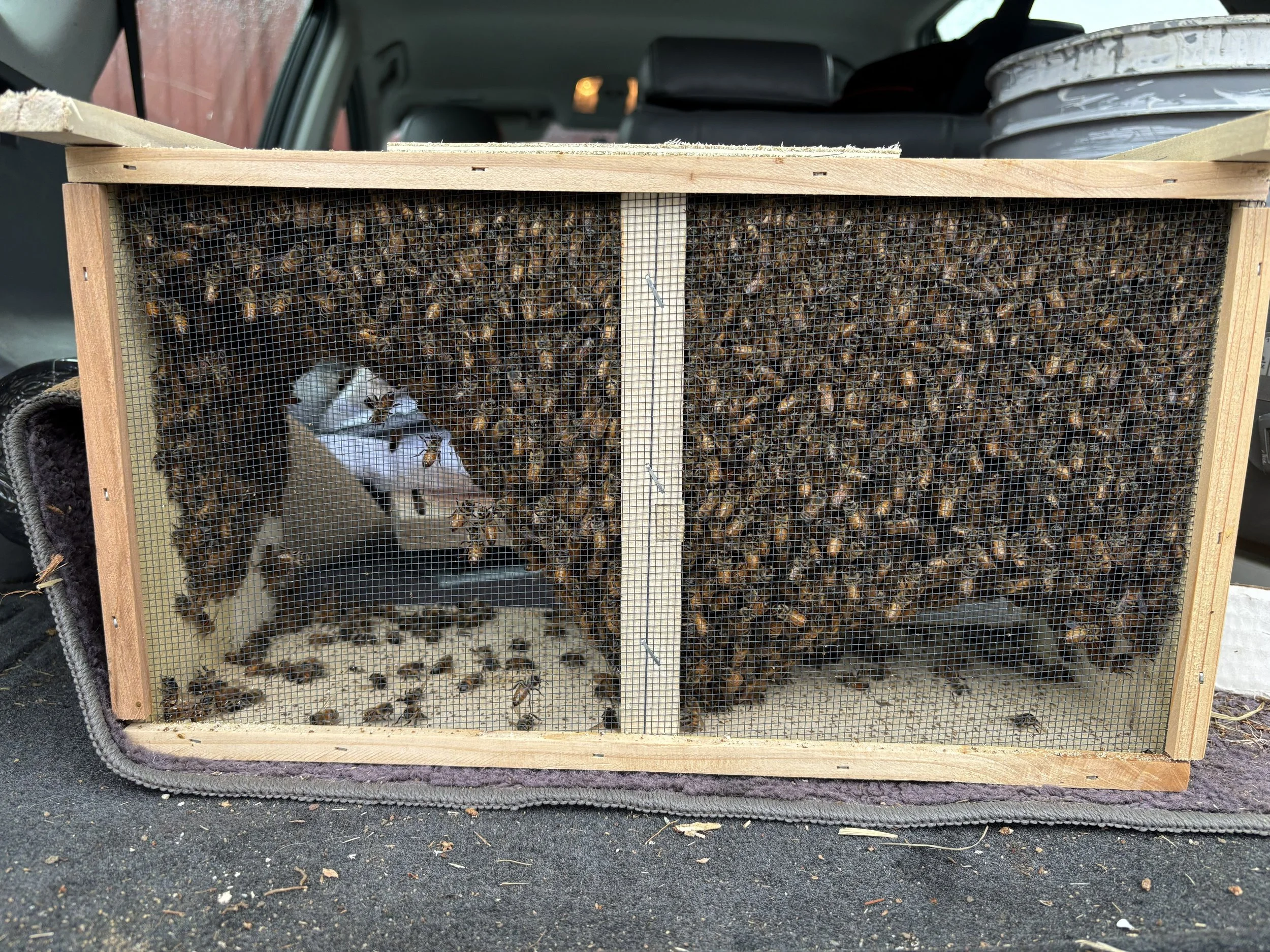
Our package of bees as it appeared before installing it into the hive.
New to the farm crew this year: honeybees!
This year, I am very excited to be piloting the introduction of honeybees into the ranks of helpers tending the farm. The potential benefits of having these busy pollinators on the farm are so many, including not just increased vegetable and flower production, but more high- quality produce, as bees ensure complete fertilization. The amount of work these creatures do is staggering—one single worker bee visits on average 20,000 flowers in its short life span of 4-6 weeks! And it takes a mind-boggling 2,000,000 flower visits to make 1 pound of honey. Honey is only a secondary motivator for starting the hive—apparently, it’s uncommon to be able to harvest honey in the first year. But if that’s a side benefit of tending to it, I will not complain! I was also just fascinated by bees in general and interested in the overall ecological benefit of introducing more pollinators. My curiosity has only deepened as I’ve started learning the fascinating details of their world, and the world of the people who take care of them.
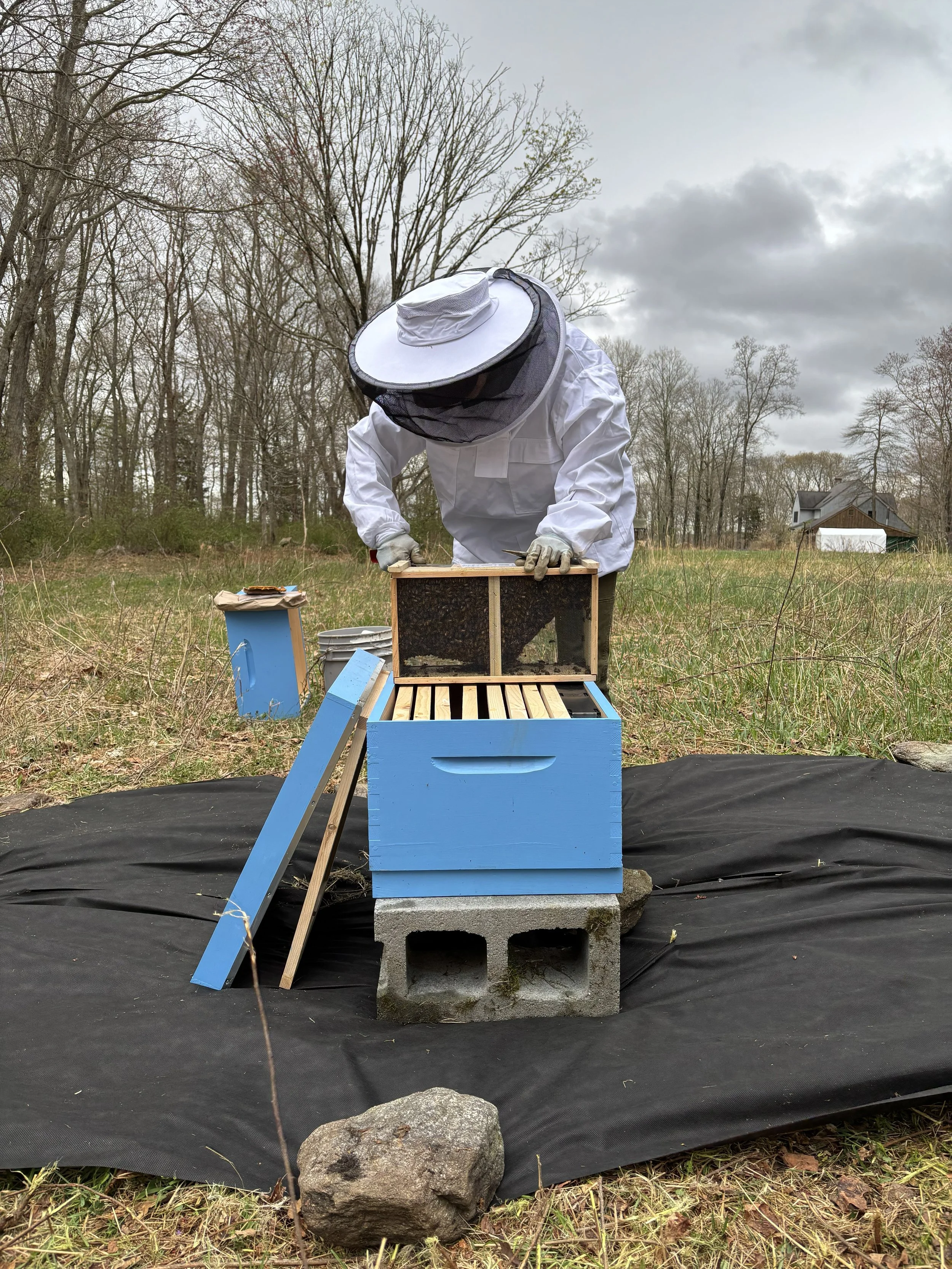
Standing in the wind and the impending rain getting ready to open the package for installation. Installation involves a few tricky moves of getting the queen out first, then getting the simple syrup out, without letting the rest of the bees out. It was harder than I expected the first time!
We decided to start small this first year with just one hive in order to better gauge how much work it is to take care of a beehive. How do you start a hive you ask? It turns out, as with most beekeeping things, there are many ways—including, for experienced beekeepers, catching a swarm of bees in the spring and giving them a home. But for this initial go-round, I purchased a “package” of bees, which were driven up from Georgia by Stuart Woronecki of Stonewall Apiary in Hanover, CT. A package is a small wooden-framed box with screen on two sides (see image 1), that comes with 3 pounds of bees (roughly 10,000 bees), a can of simple syrup, and a queen bee in a cage. The queen bee that comes with the package is not the mother of the bees in the package—they are raised separately—so the queen must stay in the cage for the first week or so while the workers adapt to her pheromones and accept her as their queen. We are hoping to eventually find a local queen bee, who can help us change the character of the hive from bees from out of state to local honey bees, who may be more adapted to surviving through this area’s winter conditions.
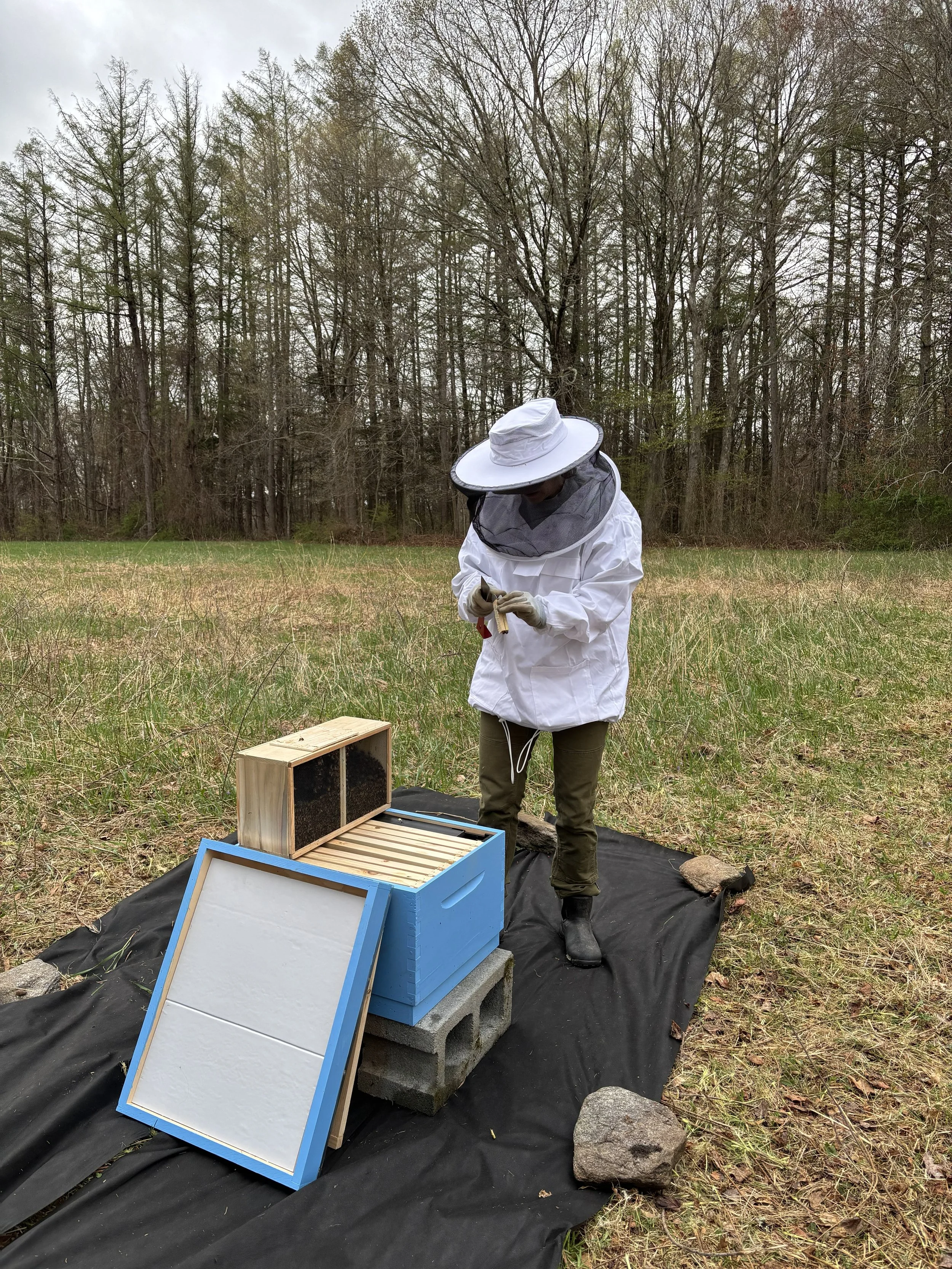
Another view on the hive set up. If you look closely, in the image, I am holding the queen cage.
A quick aside here with some basics on bee biology—every hive has only one queen, whose sole responsibility is to lay eggs for more bees. She actually does not even feed herself or clean herself—that is done by a group of about a dozen attendant worker bees. The majority of the bees in a hive are female worker bees, with a small percentage of the overall hive being male drone bees, who interestingly do not have a stinger. The workers are the only ones that forage for nectar, and the main function of the drones is to mate with another queen. With any luck, we will be able to grow our hive into a strong colony of somewhere around 50,000 bees.
I am using a 4-part hive, with two boxes on the bottom for brood (new bees) and two boxes on top for honey. We started in mid-April with just one bottom box, and will add boxes as the season progresses and the hive expands. In fact, we added the second brood box in mid-May, about a month into the process (see image 3). I have been feeding the bees 1-to-1 simple syrup and supporting them to get established, but the native blooms will just continue to pick up in addition to the wave of activity now erupting on the farm.
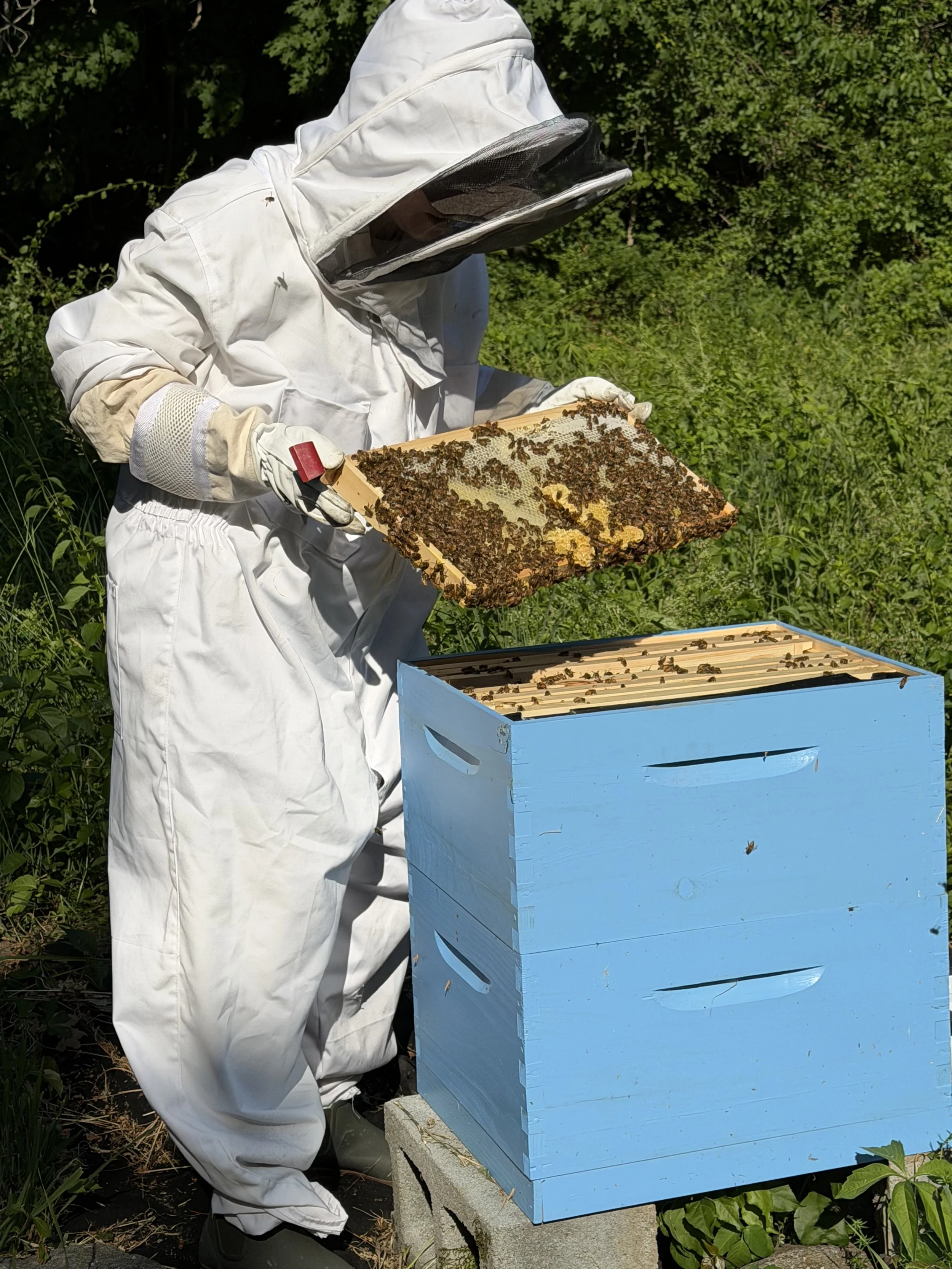
Me doing a hive check in early June, pulling out a frame from the second brood box we added in May.
Each time I visit them to check and feed them, I learn something new, and the more I learn about bees, the more my mind is blown! In parting, here are a few bits of trivia that for me, as a novice, have just been incredible to learn:
– Honeybees have been around for about 120 million years, and have co-evolved with flowers and plants as their most significant pollinator
– Genetically speaking, a queen bee and a worker bee are identical. The only difference between them is that queen larvae are fed a greater quantity of royal jelly—a highly nutrient dense substance produced by the worker—which activates a different expression of their genes! This different expression includes ovaries and an enlarged abdomen, making her physically distinct from the other workers in the hive. This happens just through food!
– Did you know that bees are trucked in from all over the United States to support the bloom of almond trees in California? It’s called migratory beekeeping, and 30 billion honey bees are brought in from all over the U.S. It’s one of the largest movements of animals on the planet. More than 100 million almond trees flower at the same time, and the bees will need to visit each of them in about 6 days, visiting up to 5,000 flowers in a day.
Thanks Sam! We’re looking forward to watching how the hive grows and expands on the farm (and to taste some Four Root Farm honey one day)!